A Winter Day on the Highland Scenic Drive
I left Charleston at twenty till seven in the morning with the porch thermometer holding at nineteen degrees. The Highland Scenic Highway carries twenty-two miles of pavement that nobody plows once winter settles in. I knew the gate across that stretch would be shut before I ever put the truck in gear.
Going anyway is not stubbornness. The road below the gate stays open all year, and it climbs enough to show you what the high country is doing. The mountain does not close for the season. Only the pavement across the top of it does.
So this was a day of driving to a barrier and then walking, which sounds thin until you stand up there. Wind, spruce, and a sky moving fast will make a long day feel short. Then the light quits behind the ridges at an hour that still catches me every February.
The road out
Interstate 79 north to the Sutton exit took an hour and five minutes on dry pavement and thin traffic. US 19 south from there reaches Summersville in about twenty-five minutes, with the sky still gray at the edges. I stopped once to scrape a glaze off the windshield that had formed while I was standing beside the truck.
WV 39 leaves Summersville heading east and starts working right away. Craigsville, Fenwick, Nettie: the towns come in that order, each one a short row of buildings and a bridge. Past Fenwick the road tightens, the shoulders narrow, and the plow berms were still standing three days after the last snow.
Richwood sits in a bowl of hills at about 2,180 feet, and my truck read twelve degrees as I came through town. From there WV 39 and WV 55 run together and climb steadily east toward Cranberry Mountain. That grade is roughly nine miles of steady work with two long curves and a runaway lane on the far side.
The pavement was clear and salted the whole way up, but the shade pockets carried a shine. I took those in second gear at twenty-five miles an hour and let the one truck behind me go by.
Where the gate stands
The Cranberry Mountain Nature Center sits at about 3,400 feet, where WV 150 leaves WV 39 and 55. The building is shut in February, and the lot held eight inches of settled snow with one set of tire tracks through it. I parked at the plowed edge and pulled on the boots I keep behind the seat.
The gate across WV 150 is a plain steel arm with a reflector bolted to it. It is not dramatic and it is not hidden. The forest closes that section every year once the snow comes, and it opens again when the melt and the road work allow.
Past the arm the pavement is still pavement, buried under packed snow with a ski track down the middle. Foot travel is allowed there, and that is the whole point of a February run. I went in one and two tenths of a mile by the map on my phone, then turned when the wind got serious.
Nobody passed me on foot or otherwise. I heard one raven and, somewhere far to the north, a snow machine that I never heard again.
Spruce and wind
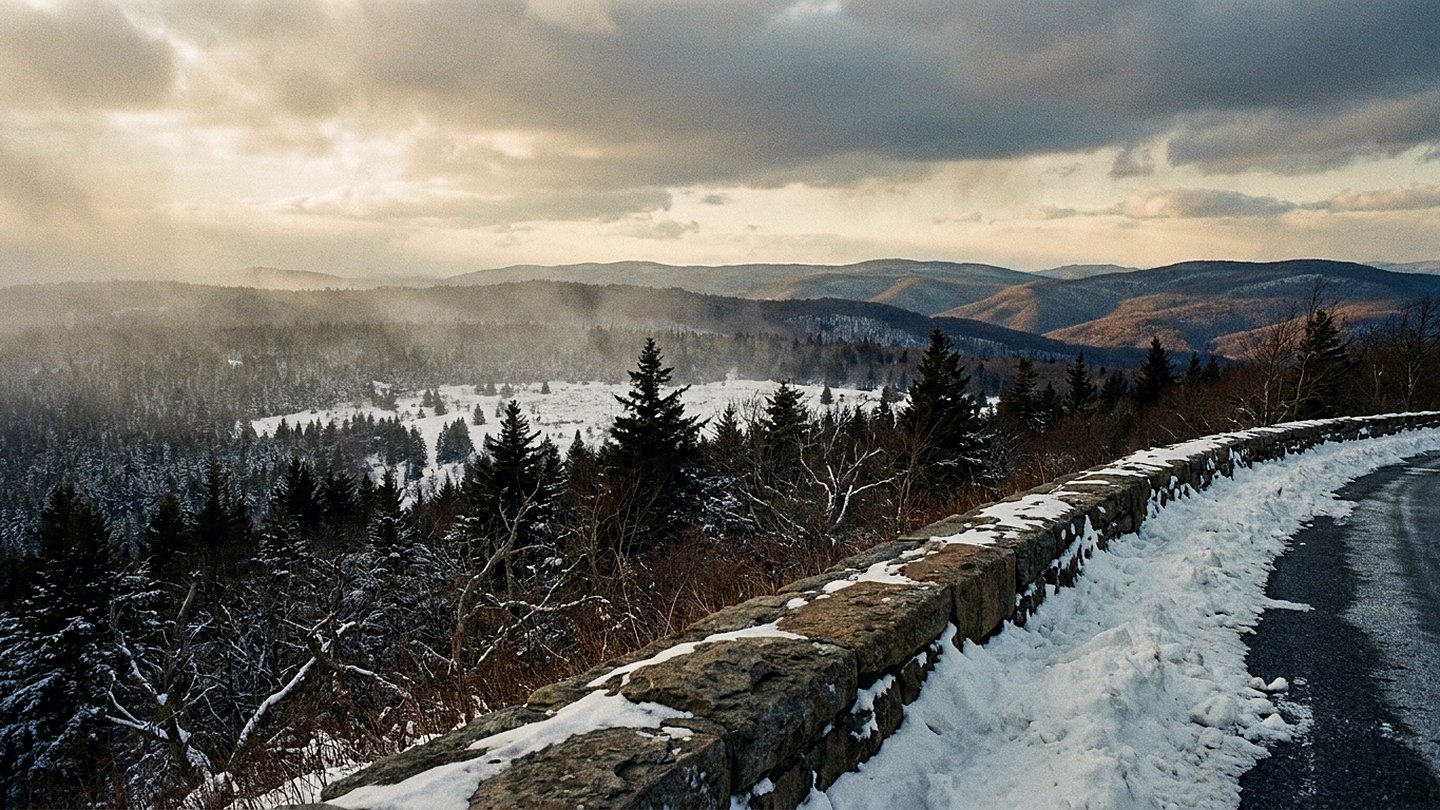
Red spruce is the reason the top of that mountain feels like a different state. The trees stand close and dark, and at that elevation they catch rime from any cloud that drags across them. On this morning the rime ran an inch thick on the windward needles and fell in sheets when a gust hit.
The sound is what I did not expect the first time I came up in winter. Spruce does not rattle the way a bare hardwood ridge does in January. It hisses, low and steady, and the pitch climbs when a gust runs the length of the stand.
The stand along that road is not uniform, and the edges tell you where the wind works hardest. Where the cut opens up, spruce gives way to a fringe of yellow birch and mountain ash, both bare in February. That edge is where the drifting happens, and I crossed two long tongues of snow at shin height.
Between the trees the ground is bog in summer and a white flat in February. Cranberry Glades lie below and west of that shoulder, and the basin held standing cloud all morning. From the road I could see the top of that cloud, which is a thing the high country does and I never tire of.
My hands were done at twenty-five minutes. The wind held near twenty miles an hour with gusts that turned me sideways, and the air temperature was fourteen.
What the light did
I was back at the truck by twenty past one, three and a half hours after I parked, which felt like late morning and was not. February tenth gives Charleston a sunset near five fifty-seven, and on the shaded side of a 4,000-foot ridge the useful light quits well before that.
So I drove down the way I came, with one stop at the Williams River bridge below the mountain. The water ran low and clear, with ice shelves out from both banks and a black seam down the middle. I stood there eleven minutes, and in that time my truck door froze partly shut.
The overlooks I would have wanted, Big Spruce and Little Laurel and Honeycomb Rock, all sit on the closed section. They will keep. I have seen them in June and in October, and in both months the pull-offs were full of people doing exactly what I was doing.
Coming off the mountain I met the only other traffic of the afternoon, a plow running with its blade up. He had the whole road and I gave him most of it. Below Fenwick the light went yellow and low across the fields, and the ice on the ditches turned the color of weak coffee.
Richwood at twenty past two was already in shadow, though the sky above it was bright. By Summersville the sun sat low and orange over the hills, and I still had ninety miles to run.
What it came to
Eleven hours door to door, 264 miles, and three hours and forty minutes actually out of the truck. Driving took five hours and fifty minutes. An hour and a half went to stops that were neither driving nor looking at anything worth writing down.
This is not a February trip for everyone. There is no open building at the top, no shelter from the wind, and no phone signal I would count on east of Richwood. The walking surface past the gate is packed snow over pavement, which means ice under the powder in the ruts.
If you want the four overlooks, come between late spring and late fall, when the high section is open and the pull-offs are cleared. If you want the mountain with nobody on it, come in February and accept that you walk to whatever you get.
I parked at home at twenty till six with about twenty minutes of daylight left in the yard. The porch thermometer read twenty-nine, and after the ridge that felt warm.
The count
- Time out of the truck 3 hours 40 minutes
- Driving 5 hours 50 minutes
- Daylight left when I parked at home 20 minutes
Checked against
- Seasonal gate and closure notes on the national forest district pages
- Overlook names, elevations, and mileages listed by the national forest
- Point forecasts and ridge wind notes from the national weather service office
- Sunset and civil twilight times from national weather service daylight tables

Wes CardwellFounder and editor. Charleston, West Virginia. Every trip on this site was driven, walked, and timed by hand.