A Swinging Bridge Over Cabin Creek
There is a kind of bridge in this state that shows up on no highway map. It is a footbridge on cables, two feet wide, strung across a creek to reach houses on the far bank. Cabin Creek has several of them, and on a Tuesday in March I went to stand on one.
I have driven that hollow for twenty years and never once stopped. That is the usual way with things close to home. This time I gave the morning an hour on the ground and drove out with no other purpose at all.
The creek was up. Two days of rain had come through the weekend before, and everything in Kanawha County was running brown and loud. That turned out to be exactly the right condition for what I wanted to hear.
The drive out the hollow
Downtown to the mouth of Cabin Creek is fifteen and eight tenths miles on the river road. I left at eight and made it in twenty-six minutes, slower than the map thinks. The town limits through Marmet and Chesapeake account for most of that.
The river road is four lanes for a while and then narrows down to two. Water sits on the right and the hill on the left for most of the way. In March the hillside is still bare, and you can pick out every cut and old grade stacked above the pavement. There is more built into those slopes than anybody notices in July.
At Dry Branch you leave the river and turn up the creek. The hollow road is two narrow lanes with no shoulder, and it climbs gently for five miles between the water and the hill. Houses sit on both sides, some on the road and some across the creek, and that is the whole reason the footbridges exist.
I found a gravel pull-off big enough for two vehicles about a quarter mile below the bridge I wanted. The gravel was soft from the rain, so I backed in rather than try to turn around on the road itself.
Standing on it
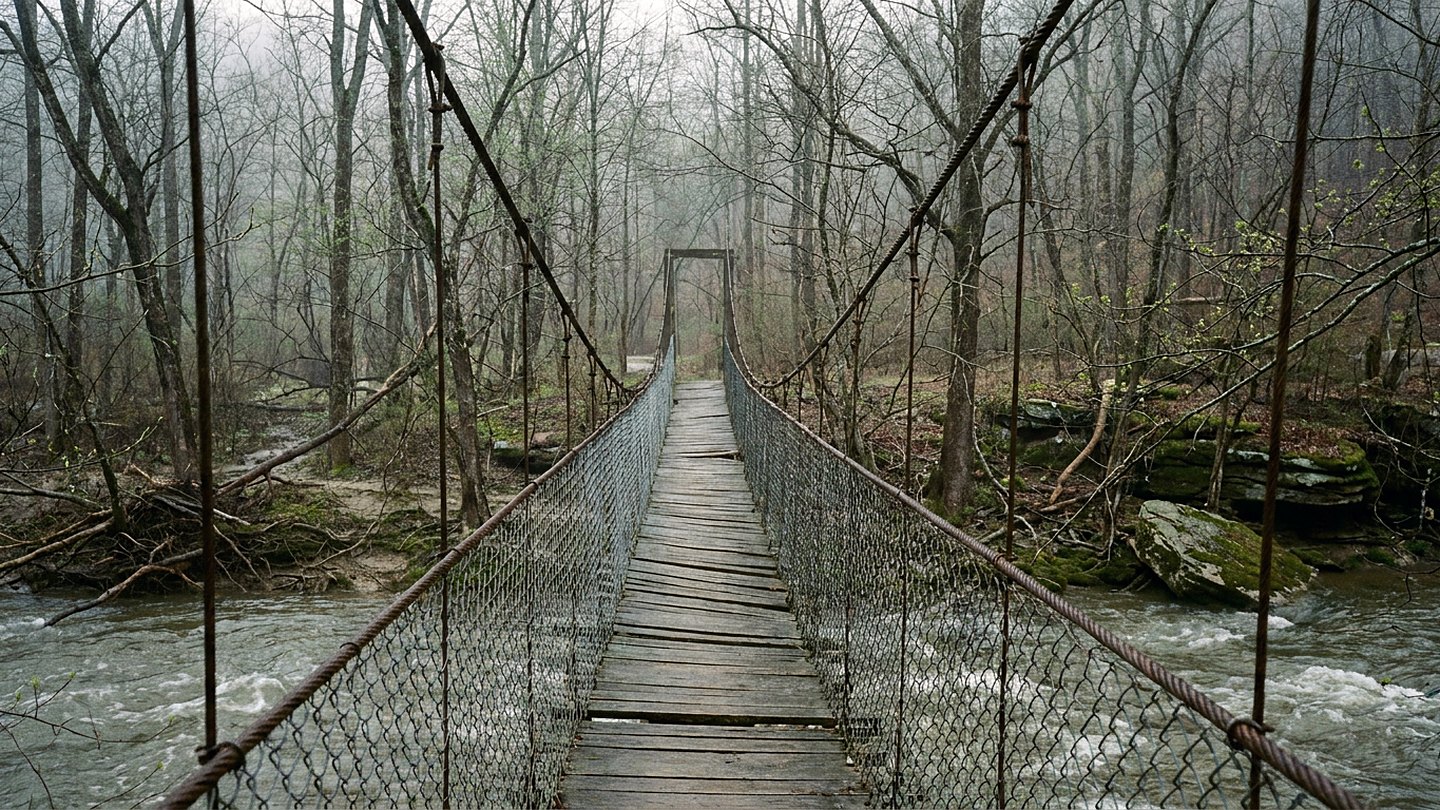
The bridge is somewhere near fifty feet across. Two main cables carry the deck and two more run at hand height as rails. Vertical hangers tie the rails down to the stringers every three or four feet.
The deck is wood, laid crosswise, about two feet wide. The boards are not uniform. Some are newer and pale, and some are gray and worn down along the edges. Two boards near the middle had been replaced with something noticeably thicker.
The far end lands on a concrete pad set into the bank. The near end comes down to a short set of wooden steps and a gate that was standing open. Everything about the thing says it gets used and it gets fixed, not that it gets admired.
The first thing you learn is that the sway is not side to side. It is a long slow rise and fall that follows your own steps, and it builds if your pace happens to match it. Take four steps in rhythm and the deck starts working along with you.
I found that a short irregular stride kills it. So does stopping. I stood still in the middle for a couple of minutes and the span went quiet. Then, and only then, I could hear what I had driven out there for.
The creek, loud
Under the bridge the water was maybe eight feet down and moving hard. Brown, carrying leaf pack and small limbs, and loud enough that the road behind me disappeared out of hearing completely.
A creek at that level makes one particular sound: a low steady roar with a higher note laid over it where the water breaks around something fixed. That morning the higher note came from a concrete slab in the streambed, most likely an old crossing.
I stayed on the deck about twenty minutes. In that time one truck went by on the road and a dog started up somewhere. A crow worked the trees on the far bank for a while. Nothing else happened.
The light was flat under cloud, which suited the place. On a bright day the creek reads as glare and black shadow. On a gray one you see the color of the water and the gray of the boards and very little else.
Who uses it
Two people crossed while I was there. A woman came over from the far side at about ten till nine, carrying a bag, and got into a car at the pull-off. She walked it at a steady pace and the deck barely moved under her.
Twenty minutes later a man came down the road and went the other way, up the steps and across, with no hesitation at all. Neither of them looked at the water. To me it was the whole point of the morning. To them it was the way to the house.
That is worth saying plainly. This is not an attraction. It is simply part of somebody's way to their own front door. Standing on it for an hour makes you a guest rather than a visitor.
I kept off the far bank for that reason. The bridge lands in a yard, and a yard is not public ground. I turned in the middle and came back the way I had gone out.
What took the time
One hour and four minutes from the pull-off back to the pull-off. Very little of it was walking: two crossings of fifty feet each, a short stretch of road, and a long spell of standing.
The time went to three things:
- Learning the sway, which took ten minutes of going back and across before it stopped surprising me.
- Standing still in the middle listening to the creek, about twenty minutes of it.
- Looking at how the thing is built, which held me longer than I expected it to.
What it came to
Forty-one and six tenths miles of driving, one hour and eighteen minutes moving, and one hour and four minutes on the ground. I was home by half past ten with nine hours of daylight and the day still open in front of me.
The footing needs a word of its own. The deck has real give in it, and the boards do not sit level with each other. The cable rails are at hand height rather than the height of a stair rail. There is nothing below those rails, so the sides of the deck are open.
This one does not suit anyone unsteady on their feet, and it does not suit small children without a hand to hold. The gravel pull-off goes soft after rain, and there is no room to turn around on the hollow road itself.
It also does not suit anyone looking for a view. There is no view. There is a creek, a wooden deck, four cables, and the sound of high water. On a gray March morning that was enough to fill an entire hour.
The count
- Time on site 1 hour, 4 minutes from pull-off to pull-off
- Driving 41.6 miles, 1 hour 18 minutes moving
- Daylight left 9 hours, home by half past ten
Checked against
- Kanawha County pages describing the Cabin Creek district, road maintenance, and public crossings
- Kanawha Valley historical society material on the coal camps along Cabin Creek and their footbridges
- National Weather Service rainfall totals for the Kanawha Valley for the preceding weekend

Wes CardwellFounder and editor. Charleston, West Virginia. Every trip on this site was driven, walked, and timed by hand.