First Light at the Kanawha Riverfront
The alarm went at ten past six, which in January is still full dark in Charleston. I had made the coffee the night before and I left the television off. The whole point of the morning was to hear the river before the city got loud.
Sunrise was posted at seven thirty-nine. I wanted both boots on the wall by seven, with half an hour of gray light to stand through first. That gray half hour is the part most people skip, and it is the part that makes the rest work.
This one is small on paper. Under five miles of driving, a little over an hour standing still, and home before the first meeting of the day. On the ground it did not feel small at all.
Getting down there in the dark
From my street on the East End to the boulevard is two and three tenths miles. I drove it in eleven minutes with two lights against me and almost no other traffic. The pavement was dry the whole way, which in January is not a given here.
The car thermometer read twenty-eight degrees when I shut the door. Wind was the number I had checked the night before, and the forecast had it under five miles an hour. Down on the water that matters far more than the temperature does.
A still twenty-eight degrees is comfortable in a coat and gloves. A twenty-eight with wind coming up the valley will send you back to the car in ten minutes. I have made that mistake twice and I no longer go down there without looking.
I left the car in a marked spot along the boulevard, on the block above the wall. There are stairs down to the walkway and a ramp about a hundred yards east of them. I took the stairs going down and the ramp coming back, mostly because my knees vote at that hour.
The river at first light
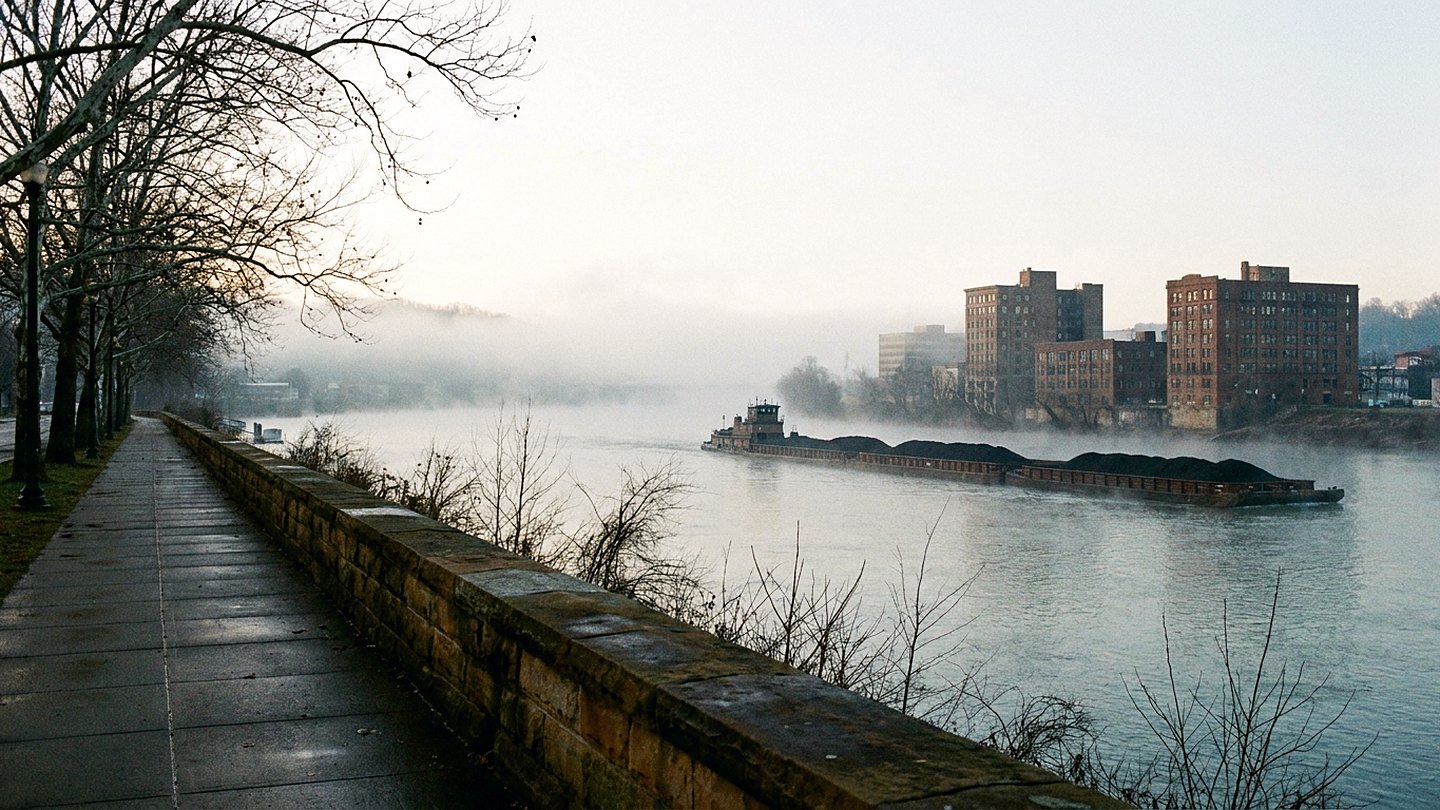
The Kanawha was steaming. That happens when the water is warmer than the air sitting on it. On a calm morning the vapor stands up in ropes instead of blowing flat. It drifted downriver in sheets, thick enough in places to hide the far bank entirely.
The far shore came and went. For a minute I could see the ridge behind the south side houses, and then it was gone again behind the white. The hills above this city are low and close, and in winter they read as gray brushwork with no depth in them.
Behind me, downtown was starting up. I heard a truck compressor two streets north, a door on a loading dock, and the first bus of the morning taking a corner. None of it reached the water. That is the odd thing about this walkway: the city is thirty feet behind you and sounds like it is across a field.
At seven twenty-two the light changed. It does not arrive as a proper sunrise down here in the valley. The ridge to the east holds the sun back for another half hour. What you get first is the sky going from slate to a dull peach, and the steam picking that color up off the surface.
The tow, and what it takes to move it
At seven thirty-one a towboat came up from the west, pushing barges. I counted six loaded, in two strings of three, riding low with coal. The boat itself is small compared with what it moves, which is the part that never quite makes sense to watch.
It took nine minutes to pass the point where I stood. Nine minutes for one boat to clear one man on a wall, and it never seemed to be in a rush about it. The engine noise carried across the water flat and low, more felt in the chest than heard.
The wake reached the near bank about a minute after the last barge went by. It slapped the stone in a slow rhythm for another two or three minutes after that. Then the river went back to being flat and steaming, as if nothing had come through at all.
Upriver, the gold dome caught the first real light while I was still watching the barges. It is the only thing in that view that goes bright before anything else does. As a piece of architecture it deserves the attention, standing where it does above the bend.
What the hour actually asked
I stood in one place for most of it. Sixty-five minutes on the walkway, and I covered maybe six hundred yards of pavement, back and forth between the stairs and the ramp.
Three things took the time:
- Waiting through the gray. Twenty minutes of nothing changing, which is what it takes to see it change.
- The tow passing. Nine minutes, plus the wake, plus the quiet that came after it.
- The slow walk back east along the wall, because the light was still moving and I was not finished looking.
The cold asked something too. My hands were fine in gloves and my face was fine as well. Standing still at twenty-eight degrees is a different thing from walking in it. I would put a fifteen-minute limit on standing still without a hat.
What I did not plan for
Two people passed me the whole hour. A runner went west at about ten past seven, and a man walked a dog east around seven forty. Neither of them said anything. On a January weekday before eight, that walkway is effectively empty.
I also did not plan for the geese. A line of them came off the water near the mouth of the Elk around seven thirty-five. They went over low and loud, and settled again a hundred yards down. That was easily the loudest thing that happened all morning.
The last surprise was how fast it ended. Once the sun cleared the ridge, the steam was gone in under four minutes. The river turned from white to a plain brown gray, and the whole reason I had come was simply over.
What it came to
One hour and five minutes on the walkway. Four and six tenths miles of driving, with twenty-six minutes of that time moving. I was back at my desk by twenty after eight with nine hours of daylight still ahead of me.
The ground is level, paved, and easy. There are stairs at the near end and a ramp a short way east, so the footing is not a problem for most people. There is no shade along that stretch, which does not matter in January and would matter quite a lot in July.
This one does not suit anyone who needs a warm place to stand or a restroom within reach. Nothing along the boulevard is open at seven on a winter morning. It also does not suit anyone who wants a wide open sunrise. The ridge holds the sun back, so you get color long before you get sun.
If you can be still for twenty minutes in the cold, it is the easiest hour in the city.
The count
- Time on site 1 hour, 5 minutes standing and walking the wall
- Driving 4.6 miles, 26 minutes moving
- Daylight left 9 hours, the whole working day ahead
Checked against
- City of Charleston parks and recreation pages, for walkway access points and winter gate hours
- National Weather Service forecast, sunrise listing, and river observations for the Charleston area
- Kanawha County public information pages describing riverfront access along the boulevard

Wes CardwellFounder and editor. Charleston, West Virginia. Every trip on this site was driven, walked, and timed by hand.