Three Overlooks on the Gorge Rim in January
In January the gorge gives up its cover, and the rock stands out along the whole rim. I left Charleston at half past ten with a thermos and a wool hat. The plan was three railed platforms in one afternoon, with no ropes and no boats. I wanted to see how much of the canyon reads once the leaves are down.
Winter changes what a rim walk asks of a person who stands still and looks. The platforms are open, the handrails are cold, and the wind comes up the wall in pushes. Nothing about the day was hard, but every part of it was exposed to the weather. I dressed for standing rather than for walking, and that choice turned out to be right.
This is a driving trip with short walks attached, and it is not a hike in any real sense. Two of the three stops sit within a few hundred feet of a parking lot. The third asks for a long stair run that I would skip on any icy morning. I went on a dry bright day, and I would wait for another one before repeating it.
The drive out
The route runs east out of Charleston on the old road that follows the Kanawha River. I stayed with it for about forty miles, through the river towns and past the locks. At Gauley Bridge the valley narrows hard and the road begins to climb in earnest. Ten more miles brought me to the four-lane, where I turned south toward the bridge.
The pavement stayed dry the whole way, with salt scatter on the shoulders and gray film everywhere. I ran the washer reservoir down to nothing before I reached the parking lot. Fog sat in the low spots near the water and lifted a little after eleven o'clock. Higher up the sky went hard blue, and the air had teeth in it.
The visitor center lot sits on the north side of the gorge, right off the highway. It measured sixty-two miles from my door, and the clock read one hour and twenty-five minutes. Six cars were parked when I pulled in, and three of them left within ten minutes. In summer that lot fills and spills onto the grass, but January leaves room to spare.
The upper platform
The boardwalk starts behind the building and runs level for a couple of hundred feet. Planks were dry in the sun and slick in the shade, which is the usual winter split. The first platform gives you the bridge broadside, one long arch across a gap of air. From there the deck reads flat and thin, and the arch under it does all the work.
I stood for fifteen minutes and watched the light move down the far wall. The rock there is layered sandstone, and in winter the ledges show as clean gray bands. Hemlock holds its green in the shaded draws, while everything else stands bare and pale. The river runs 876 feet below the bridge deck, and from the rim it looks like a seam.
Wind was steady out of the northwest at maybe fifteen miles an hour, with harder gusts. My hands were done in a quarter of an hour, and gloves fixed that problem quickly. A pair of ravens worked the updraft along the wall without a single wingbeat. That was the piece I had not planned for, and it held me longer than the bridge did.
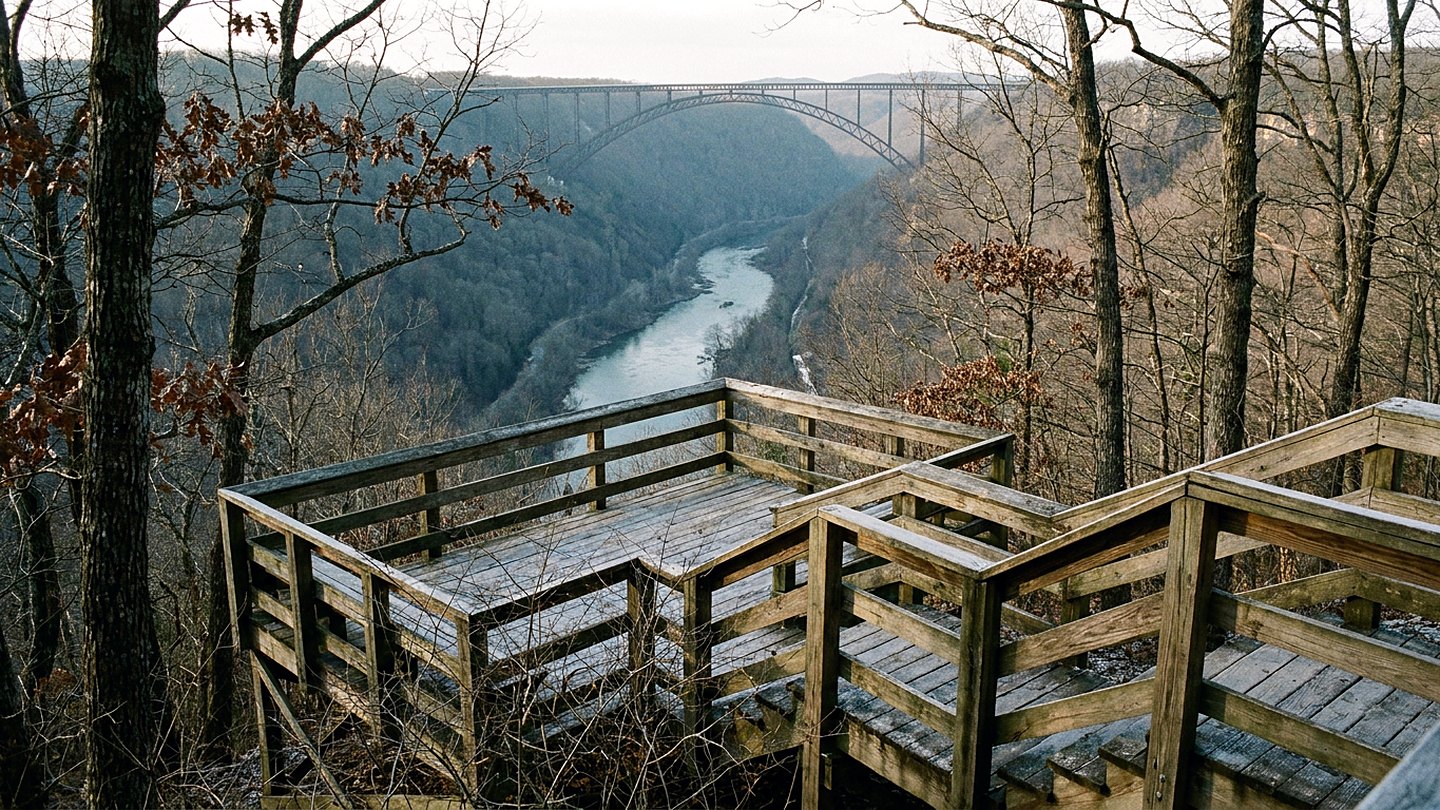
Down the stairs to the lower deck
From the upper platform the boardwalk turns into stairs and drops toward a second railing. I stopped counting steps at eighty, and there were plenty of them left below me. The stairs come in short flights with landings, so a person can stop without blocking anyone. On a January weekday I met two people going up while I was going down.
The lower platform sits well under the rim and changes the whole shape of the view. From up top the bridge reads as a line, and from down here it reads as a structure. You see the steel members, the shadow under the arch, and the river bending out of frame. That single change of height was the reason the walk down made sense to me.
Going back up took nine minutes and left me warm for the first time all day. The handrail was cold enough that I used a sleeve instead of a bare hand. Wet leaves had packed into the corners of a few landings and stayed slick the whole time I was down there. I would not take those stairs after freezing rain, and the park says as much in winter.
Grandview and the bend
From the bridge I drove south on the four-lane and then east on the interstate. It came to twenty-eight miles and thirty-five minutes, most of it easy four-lane running. Grandview sits on the rim about 1,400 feet above the river on a long shelf of rock. The main overlook is a short paved walk from the lot, with a low stone wall at the edge.
The river makes a wide bend here, and in winter you can follow both legs of it. Water was the color of slate and moved slower than I expected for late January. Two trains worked the far bank while I stood there, and the sound arrived late. I gave the overlook thirty minutes and never sat down, because the stone wall was frozen.
The road out to the far tower was gated for the season, which I had half expected. Notices at the gate said the pavement ices over and stays iced until spring. That closure took a fourth view off my list, and it trimmed twenty minutes off the drive home. Winter gates are part of the season here, and I stopped resenting them years ago.
What it came to
The day ran five hours and ten minutes from my driveway back to my driveway. Driving took three hours and twenty minutes across 158 miles, and the rest was standing time. Time on the rim came to one hour and fifty minutes spread over three platforms. I got home with about two hours of daylight left, which is a January margin.
This trip does not suit anyone unwilling to take a long stair run in cold air. The lower deck is the whole point, and the only way to it is down and back up. There is no shade problem in winter and no shelter either, so wind decides your comfort. Bring gloves, a hat, and more patience than a railing walk usually seems to require.
If the pavement is wet and the temperature sits near freezing, wait for a better day. The gorge does not go anywhere, and the leaves stay down until the end of April.
The count
- Time on the rim 1 hour, 50 minutes
- Driving 158 miles in 3 hours, 20 minutes
- Daylight left 2 hours
Checked against
- Overlook and trail pages for the national park along the New River
- Seasonal road and gate notices posted by the park
- Wind and temperature readings from the national weather service

Wes CardwellFounder and editor. Charleston, West Virginia. Every trip on this site was driven, walked, and timed by hand.